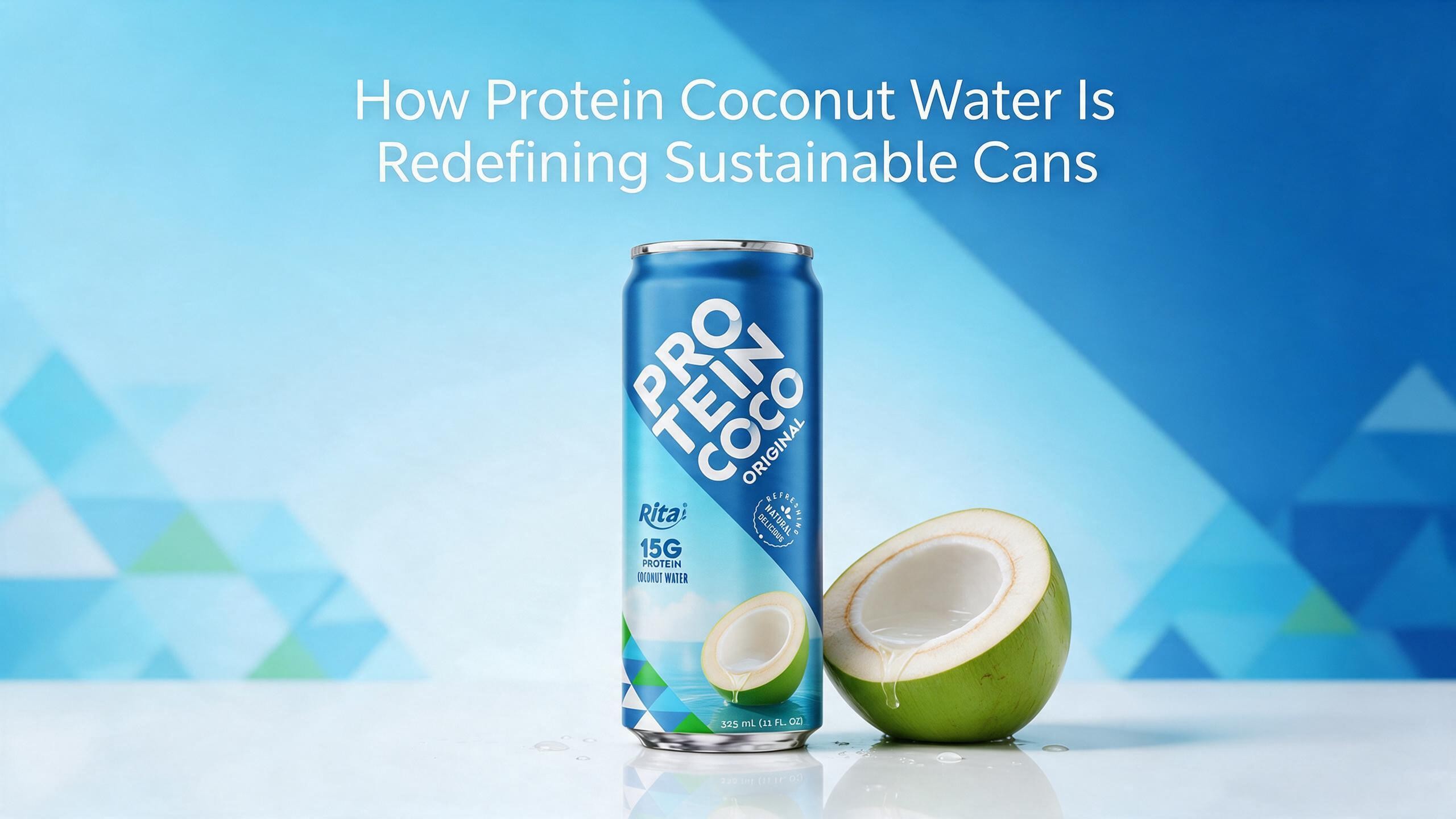
As sustainability shifts from marketing language to procurement criteria, one category is drawing attention from buyers across the United States and Canada: protein coconut water packed in recyclable aluminum cans. RITA Original Protein Coconut Water, a 325ml ready-to-drink can delivering 15g of protein per serving, shows how tropical beverage producers are combining convenience, taste, and material efficiency in a format built for North American retail shelves and distribution networks.
Key Takeaways
- The 325ml slim aluminum can format aligns with buyer demand for recyclable, lightweight beverage packaging.
- RITA Original Protein Coconut Water delivers 15g of protein and a smooth tropical coconut profile in a single serve.
- The PROTEIN COCO line covers Original, Mango, Chocolate, and Pineapple with coordinated color-coded design.
- RITA operates 50+ automated production lines and exports to more than 200 countries and territories.
- Certification coverage includes BRC, FSSC 22000, Halal, Kosher, ISO, HACCP, GMP, and SMETA.
Protein Coconut Water Meets Sustainable Packaging
Sustainability has quietly become a line item in beverage procurement across the United States, Canada, and the wider North American market.
Category managers now ask about can weight, recycled content, and end-of-life pathways before they ask about flavor profiles. For a protein coconut water brand, the aluminum can performs two jobs at once: it protects the product and it carries a packaging narrative that buyers can defend internally when shelf plans are reviewed.
Aluminum's recycling profile is well documented in industry literature. The metal can be recycled repeatedly without meaningful loss of quality, and collected cans can re-enter the supply chain within months in established collection systems. Can sheet producers have continued to raise recycled content in their material, which gives procurement teams a measurable data point for packaging scorecards. That distinction matters when a retailer compares a plastic bottle SKU with a can SKU and needs a defensible rationale for the planogram decision.
A 325ml slim can also uses less material per unit than several larger formats competing for the same cooler space.
Why Aluminum Cans Hold the Shelf
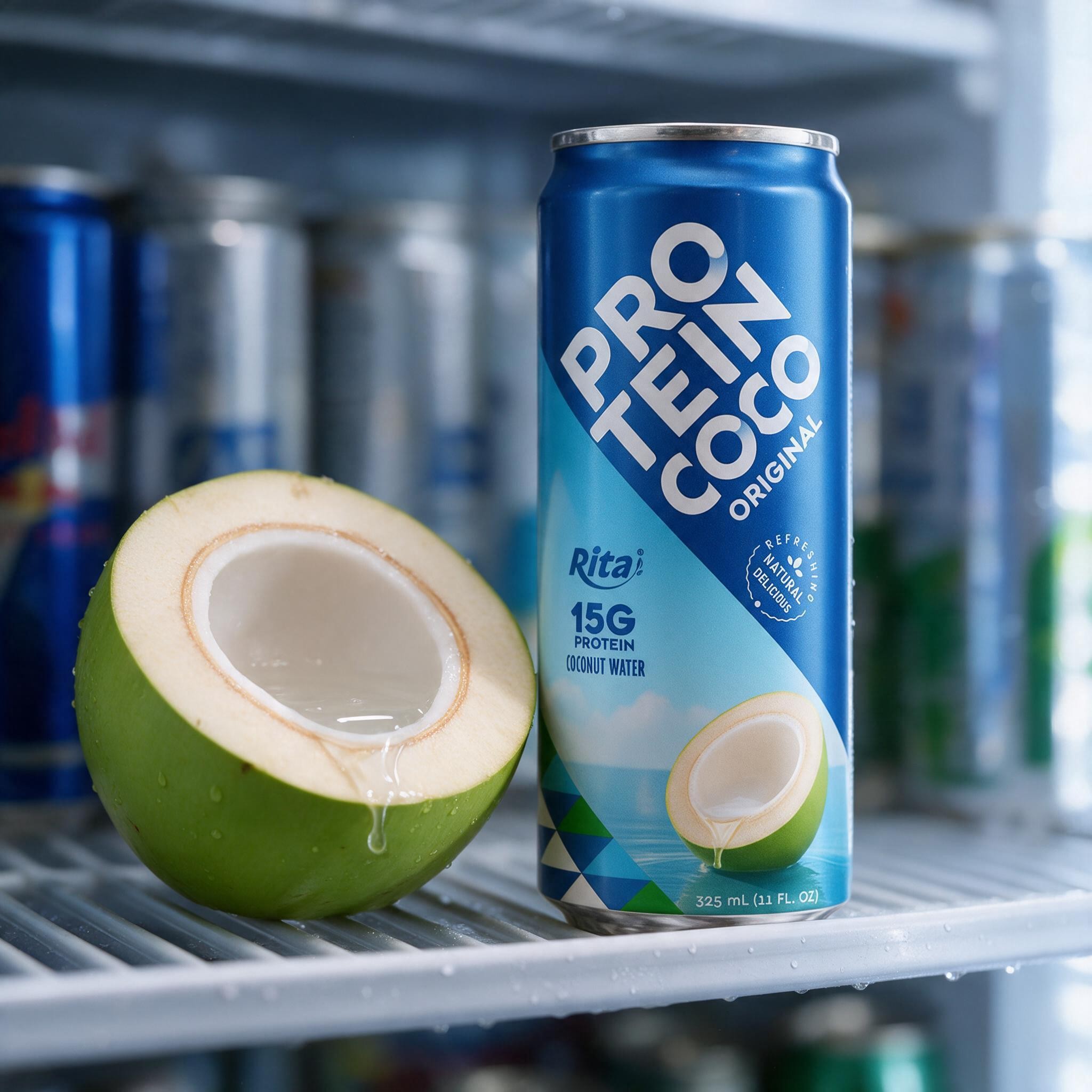
Shelf performance is a design problem as much as a materials problem. The RITA Original Protein Coconut Water can uses a diagonal blue graphic with bold PROTEIN COCO lettering, silver top and bottom rims, and a green coconut illustration set against ocean imagery, creating high visibility in a crowded chiller door.
The visual system is deliberately simple: a strong color block, a legible product claim, and a circular badge reading refreshing, natural, delicious. Slim cans stack efficiently in secondary packaging, which translates into tighter pallet configurations and fewer truck movements per case shipped. For distributors running route-based delivery in dense urban centers, that density difference compounds across a year of orders. Portability completes the picture, because a sealed 325ml can travels in a bag, sits in a cup holder, and needs no resealing between stops.
- Recyclable material supported by established collection infrastructure
- Lightweight format that reduces freight volume per unit shipped
- Full-wrap print surface for branding and on-pack information
- Reseal-free single-serve convenience for on-the-go occasions
- Ambient distribution supported by a 24-month shelf life
Inside the RITA Original Protein Coconut Water Can
The specification sheet is compact and easy to read: 325ml, 15g of protein, one can.
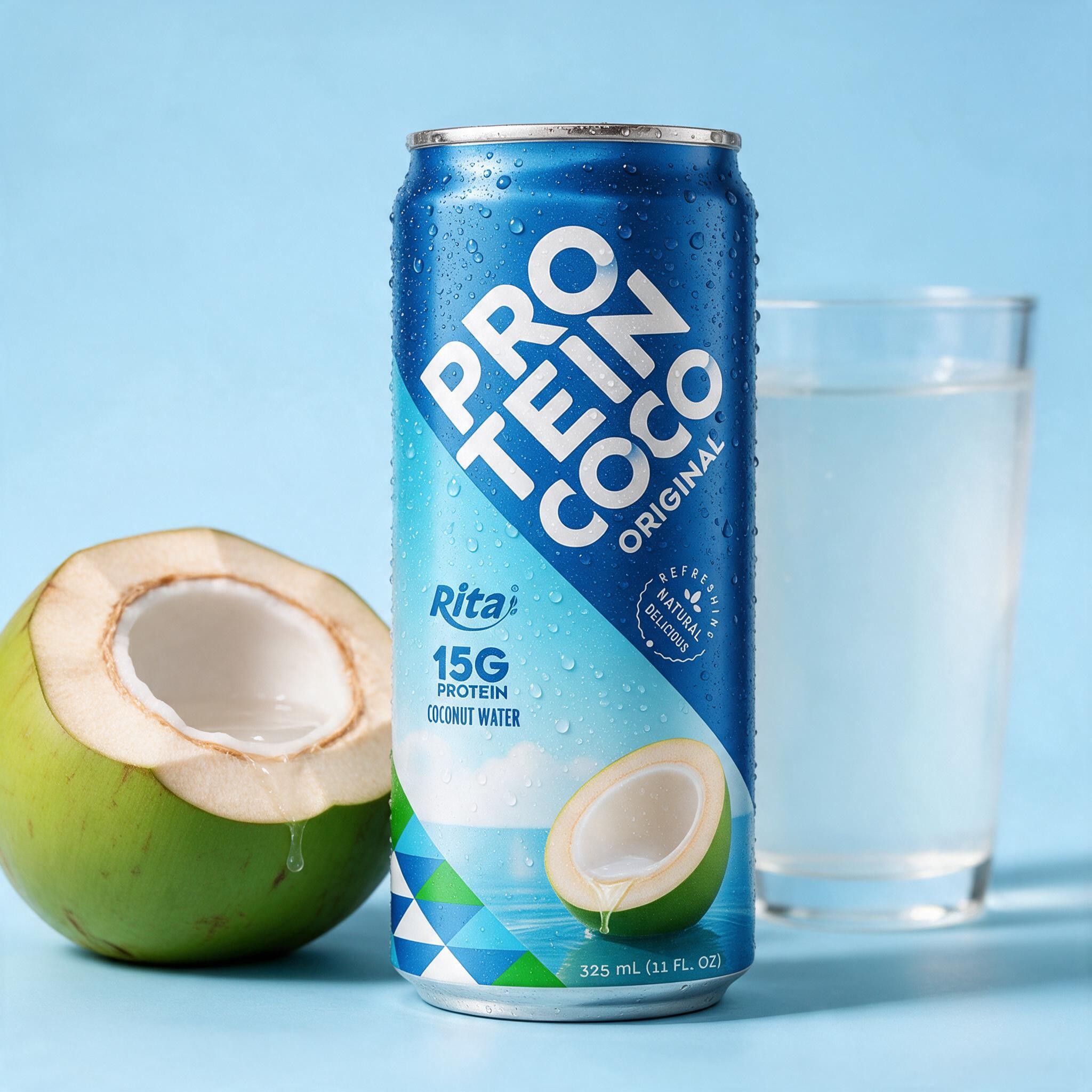
Ingredient composition covers water, coconut water base, milk protein concentrate, stabilizers, emulsifiers, and sweeteners, formulated to deliver a smooth, balanced tropical coconut flavor rather than an overtly sweet profile. Each can carries approximately 183 calories, 6.2g of total fat, and 13g of total carbohydrates, figures that buyers typically map against their own category benchmarks before a listing is agreed.
Shelf life is listed at 24 months when the product is stored in cool, dry conditions, a specification that supports long-haul export routes and staggered retail replenishment. The package is a slim aluminum can with a 325ml (11 fl oz) fill and standard ends for ambient distribution. Full technical detail for the RITA Original Protein Coconut Water 325ml can with 15g protein is published on the product listing, where importers can review nutrition panels, pack imagery, and case configuration in one place.
The PROTEIN COCO Lineup
Original is one of four coordinated SKUs in the PROTEIN COCO family.
| Variant | Can color direction | Positioning on shelf |
|---|---|---|
| Original | Blue | Core coconut profile |
| Mango | Yellow-orange | Tropical fruit crossover |
| Chocolate | Brown | Cocoa-led flavor route |
| Pineapple | Green-yellow | Bright tropical option |
Color-coded packaging lets the range block together on shelf while keeping each flavor instantly separable at arm's length. Retailers benefit from a coherent set that photographs well for digital listings, and distributors benefit from a lineup that can be ordered as a mixed pallet without SKU confusion at the warehouse.
From Coconut Plantations to Finished Cans
Raw material sourcing sits at the center of any credible sustainability narrative around a coconut-based drink.
RITA traces its primary input through its Ben Tre coconut farm program, following young coconuts from plantation rows to the point of collection, where the water is drawn before it moves into processing.
Ben Tre, in the Mekong Delta, is one of the country's most established coconut-growing areas, with a long commercial history in coconut-based products. Documenting the journey from plantation to finished beverage gives importers a traceable origin story they can repeat to their own customers. It also connects the can on a North American shelf to a specific agricultural landscape rather than an anonymous commodity stream, which is exactly the kind of detail that appears in retailer sustainability questionnaires.
A video record makes the sourcing story easier to verify than a paragraph in a supplier questionnaire, and it gives sales teams a visual asset they can circulate during onboarding.
A walk-through of the plantation and collection process is published at https://www.youtube.com/watch?v=I7hlTL3FT_0
Market Signals Shaping Protein and Coconut Beverages
Recent deal flow suggests investors still read protein beverages as an active growth lane.
Del Monte's investment in the Canadian protein-shake brand Good Protein is the clearest recent example, pairing a legacy food group with a newer protein-focused label. The move points to continued appetite for convenient, single-serve protein formats that can sit alongside established grocery portfolios without requiring a new channel strategy.
Elsewhere the picture is more mixed. A UK study found that changes to nutrient-profiling rules fall disproportionately on soft drinks, a reminder that regulatory definitions can reshape shelf composition faster than consumer preference does. The spirits sector continues to trade sluggishly with no near-term recovery in sight, while Constellation Brands divested US whiskey distiller Nelson's Green Brier and Underberg extended German distribution through a partnership with Loch Lomond whisky. The common thread is portfolio discipline: groups are concentrating on categories with demonstrable velocity and clear unit economics.
For canned coconut and protein beverages, that environment favors products with clear specifications, stable supply, and packaging that satisfies both retailer standards and consumer expectations around disposal. A protein coconut water SKU with a documented shelf life and a recyclable can format is easier to place than a concept that requires explanation at the buyer meeting.
OEM and Private Label Pathways for North American Buyers
RITA Food and Drink Co., Ltd has operated as a beverage manufacturer and exporter since 2004.
The company runs more than 50 automated production lines, ships over 1,200 containers per month, and supplies brands across more than 200 countries and territories. Its portfolio spans tropical fruit juices, coconut products, functional drinks, energy drinks, and more, packed in aluminum cans, glass bottles, PET, and PP formats for different channel requirements.
For buyers evaluating private label, the practical questions are formulation adjustment, artwork adaptation, minimum order volume, and certification coverage. RITA's OEM and ODM services address those points directly, with custom formulation and packaging options available for partners who want their own brand on a proven base liquid. Buyers reviewing coconut-based SKUs can browse the wider coconut products catalog for adjacent formats, while those mapping a full non-alcoholic range can start from the non-alcohol beverage selection.
Documentation is where export readiness is usually won or lost.
The portfolio carries BRC, FSSC 22000, Halal Jakim, Halal HCA-GCC, Kosher, ISO, GMP, HACCP, and SMETA certifications, covering the audit points most North American importers raise during onboarding. Production runs under internationally recognized quality systems, which shortens the compliance review for a new listing and reduces the number of follow-up questions during retailer approval.
Buyers moving from evaluation to sampling can start with the RITA Original Protein Coconut Water product page, where the 325ml can with 15g of protein is documented alongside the rest of the PROTEIN COCO range. The same listing supports distributor inquiries and private-label discussions, giving commercial, technical, and packaging teams a single reference point.
What Buyers Should Verify Before Listing
A short checklist keeps the evaluation focused and prevents surprises after the purchase order.
- Case configuration and pallet efficiency for the 325ml slim can
- Shelf-life window measured against planned distribution cycles
- Certification coverage relevant to the destination retailer
- Artwork adaptation timelines for private label variants
- Minimum order quantity and lead time for mixed-SKU orders
Each item maps to a commercial risk that surfaces later in the chain, which is why experienced importers settle them during sampling rather than after the first container ships. The full product listing for the RITA Original Protein Coconut Water can consolidates those details so a category team can complete a first-pass review without waiting on a separate technical file.
Frequently Asked Questions
What is RITA Original Protein Coconut Water?
It is a ready-to-drink coconut water beverage produced by RITA Food and Drink Co., Ltd, combining a coconut water base with milk protein concentrate in a 325ml aluminum can.
How much protein does each can contain?
Each 325ml (11 fl oz) can contains 15g of protein, alongside approximately 183 calories, 6.2g of total fat, and 13g of total carbohydrates.
What packaging does the product use?
The product uses a slim aluminum can with silver top and bottom rims, a diagonal blue PROTEIN COCO graphic, and a 24-month shelf life when stored in cool, dry conditions.
Can the product be ordered under private label?
Yes. RITA provides OEM and ODM services covering formulation, artwork, and packaging adaptation, with flexible order volumes for importers and distributors.
Which certifications support export of this product?
The manufacturing portfolio includes BRC, FSSC 22000, Halal Jakim, Halal HCA-GCC, Kosher, ISO, GMP, HACCP, and SMETA certifications.